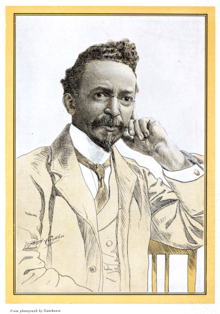
Henry Ossawa Tanner (bɛ dɔɣi o la silimiingoli June bɛɣu pish ni yini dali, yuuni 1859 ka o kani silimiingoli May bɛɣu pishi ni anu dali, yuuni 1937) o nyɛla America nucheeni baŋdi so ŋun lee n ʒini France tingbanni . Ŋuni n nyɛ tuuli gbanpiɛli gbansabinli ŋun na min di duniya zaa kpaŋmaŋ pini .[1] Tanner nyɛla ŋun daa chaŋ Paris, France, yuuni 1891 ni o ti bɔ baŋsim shikuru yuli booni Académie Julian ka di sɔŋɔ ka o pa nyɛ yuli n kpe France nucheeni tuun tumdi bɛ ni. Yuuni 1923, French gomdanti daa nyɛla ŋun piigi Tanner chevalier ka o leegi Legion of Honor.[2][3]
1989: Black Art Ancestral Legacy: The African Impulse in African-American Art. Dallas Museum of Art.
1993: Revisiting the White City: American Art at the 1893 World's Fair[12]
2010: Henry Ossawa Tanner and his Contemporaries,[13] Des Moines Art Center (December–February 2011).
2012: Henry Ossawa Tanner: Modern Spirit,[14] Pennsylvania Academy of the Fine Arts, Philadelphia (January–April), then to Cincinnati Art Museum[15] (May–September) and to Houston Museum of Fine Arts (October–January 2013)
↑ Mosby, Dewey F. (1991). Henry Ossawa Tanner. Philadelphia Museum of Art. Philadelphia; New York: Philadelphia Museum of Art; Rizzoli International Publications. p.50. ISBN978-0-8478-1346-9.
↑ Carlyn G. Crannell Romeyn(Winter 1983–1984)."Henry O. Tanner: Atlanta Interlude". The Atlanta Historical Journal27(4).“On the other hand, it is possible that some of tanner's Atlanta friends secured the three works (including The Bagpipe Lesson which won a bronze medal) for this exposition.”
1 2 3 4 5 6 7 8 9 Mosby, Dewey F. (1991). Henry Ossawa Tanner. Philadelphia Museum of Art. Philadelphia; New York: Philadelphia Museum of Art; Rizzoli International Publications. p.39. ISBN978-0-8478-1346-9. 1895 May. Paris, Salon. Intérieur Bretagne [Brittany Interior], Le Jeune Sabotier [The Young Sabot Maker], pastel of New Jersey coast by moonlight.
↑ Woods, Naurice Frank, Jr., Ph.D. Insuperable Obstacles: The Impact of the Creative and Personal Development of Four Nineteenth Century African American Artists. The Union Institute, 1993.
↑ Henry Ossawa Tanner Lot 41: Henry Ossawa Tanner, (American, 1859-1937), Woman from the French West Indies, c. 1891.“The artist arrived in Paris, France at this time and spent the summers on the west coast in Brittany. There, he adopted a predominately green palette with an emphasis on vertical brushstrokes as can be seen in the Woman from the French West Indies...we are looking at an image of a light-skinned woman from one of the islands of the French West Indies-Martinique, Guadeloupe or Dominica. This claim is supported by her costume and headdress.”
↑ Henry Ossawa Tanner (July 1909). "The Story of an Artist's Life: II Recognition". The World's Work. Vol.18 no.3. Open Court Publishing Co. p.11772. In 1895, I painted "Daniel in Lions' Den."...It was exhibited in the Salon of 1896..
Anna O. Marley, ed. Henry Ossawa Tanner: Modern Spirit (University of California Press: 2012).
Marcia M. Matthews, Henry Ossawa Tanner: American Artist (University of Chicago Press: 1995).
Kristin Schwain, Signs of Grace: Religion and American Art in the Gilded Age (Cornell University Press: 2007).
Will South, “A Missing Question Mark: The Unknown Henry Ossawa Tanner,” Nineteenth-Century Art Worldwide, vol. 8. issue 2 (Autumn 2009).
Judith Wilson, “Lifting ‘The Veil’: Henry O. Tanner’s The Banjo Lesson and The Thankful Poor,” Contributions in Black Studies: A Journal of African and Afro-American Studies, volume 9, article 4.
Henry Ossawa Tanner: Modern Spirit (University of California Press, 2012)—the most complete scholarly publication to date produced in conjunction with the Pennsylvania Academy of Fine Arts (PAFA), Tanner's alma mater






 Pomp at the zoo, circa 1880
 Pomp at the Philadelphia Zoo, circa 1880-1886
 Sister Sarah, 1882.
 Woman from the West Indies, 1891, Brittany, France.[19]
 The Bagpipe Lesson, 1893
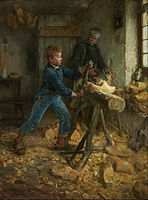 The Young Sabot Maker, 1895
 1895. Marshes in New Jersey; possibly the "pastel of New Jersey coast by moonlight" exhibited at the 1895 Salon with The Young Sabot Maker.[7]
 The Annunciation to the Shepherds, c. 1895
 The Resurrection of Lazarus, 1896. Won medal in 1897 Paris Salon, bought by French government.
 View of the Seine, looking toward Notre Dame, 1896
 Jesus and Nicodemus, 1899. Displayed at Paris Salon and Pennsylvania Academy of Fine Arts, where it won a Walter Lippincott Prize.
 Salome, circa 1900. The body of John the Baptist lies at her feet.
 Abraham's Oak, 1905. Biblical subject, also called the Oak of Mamre.
 The Savior, 1900–1905
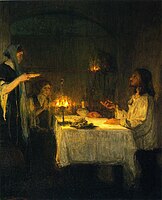 Christ in the home of Mary and Martha, 1905
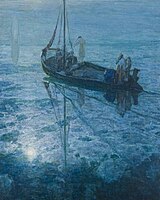 The Disciples See Christ Walking on the Water, c. 1907
 Angels Appearing before the Shepherds, c. 1910
 Christ walking on the water. Engraving, possibly a show catalog, 1910.
 The Three Marys (at Jesus' tomb), 1910. Entered in the 1910 Salon. (From left) Mary Magdalene, Mary, mother of Jesus, Mary Salome
 A View of Fez, c. 1912
 Fishermen at Sea, c. 1913
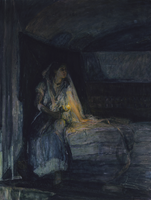 Mary, 1914
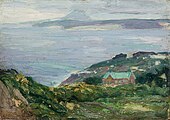 Coastal Landscape, France, 1919
 1936. Tanner's final painting, Return from the Crucifixion. Mary and Joseph are in the front.


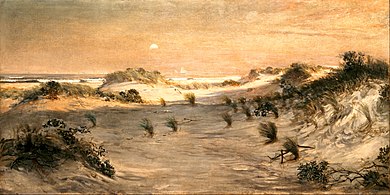 Sand Dunes at Sunset, Atlantic City, c. 1885, the White House.
 Destruction of Sodom and Gomorrah, 1929–30, High Museum of Art


,_by_Henry_Ossawa_Tanner.jpg)


